
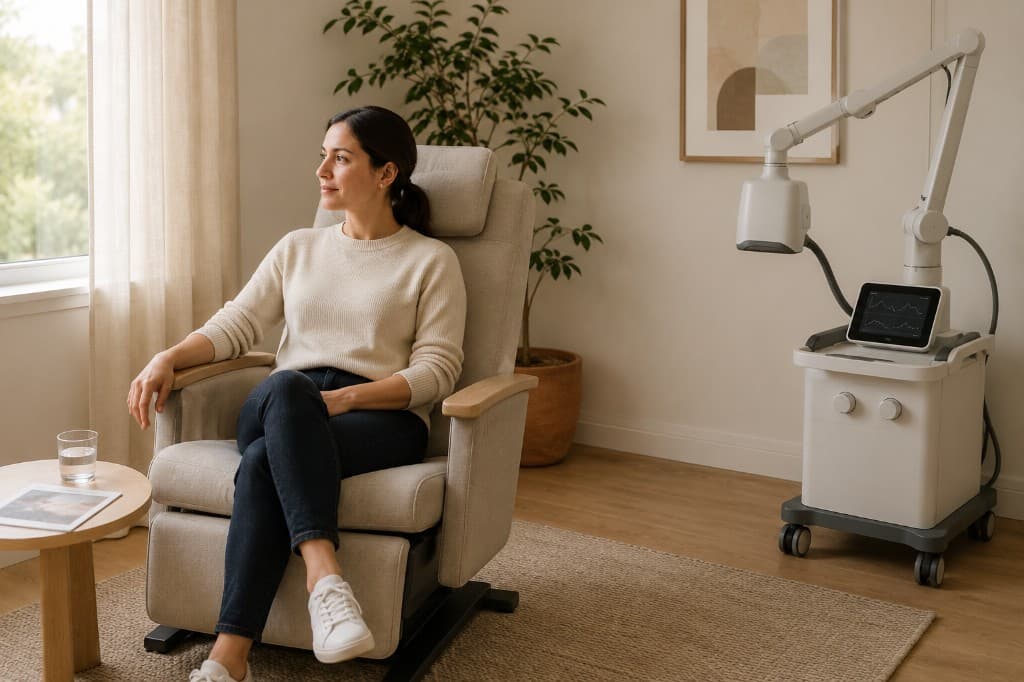
Checking in
You sign in and sit down. The technician positions the coil using the map taken at your first appointment.
TMS therapy
TMS — transcranial magnetic stimulation — is an outpatient treatment for depression that has not responded to medication. A coil placed against your scalp sends magnetic pulses to a region of the brain involved in mood. You stay awake, there is no anesthesia, and a session takes about 20 to 40 minutes.
FDA-cleared for major depressive disorder since 2008, and later for OCD. It is also used off-label for other conditions, on much thinner evidence.

FDA-cleared since 2008
For major depressive disorder

20 to 40 minutes
A typical session

No anesthesia
You drive yourself home

30 to 36 sessions
Five days a week, six to nine weeks
How it works
Three things explain almost everything about a TMS session: where the coil sits, what a pulse does, and how the dose is set for you rather than for an average patient.
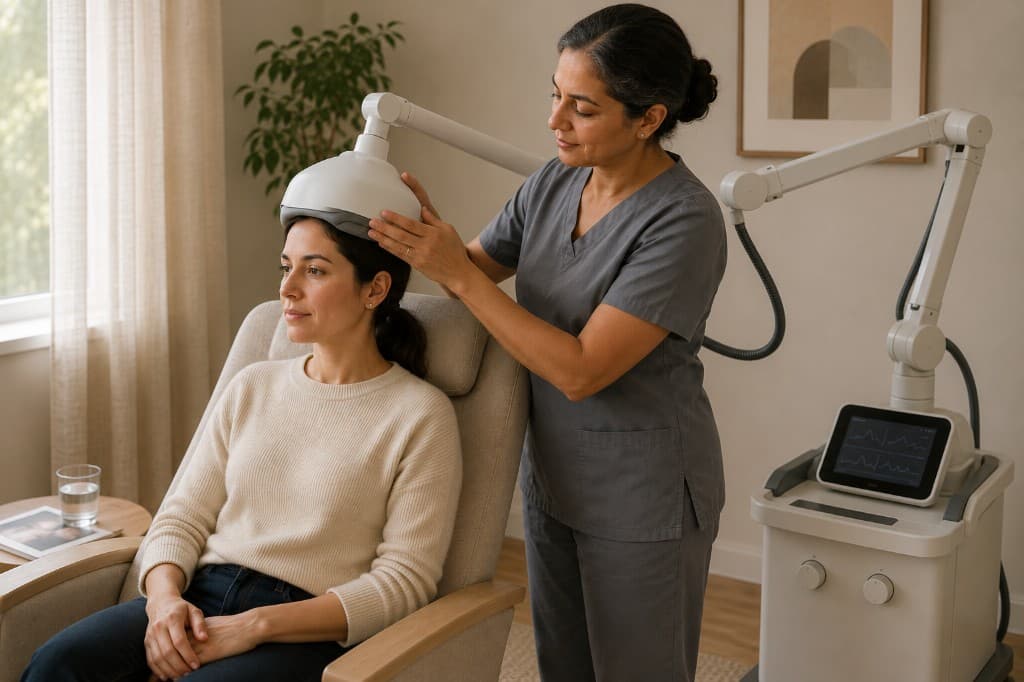
A coil rests over the left prefrontal cortex, a region involved in mood regulation. Nothing is injected and nothing is swallowed. You sit in a chair, awake, for the whole session.
The magnetic field passes through the skull painlessly and induces a small electrical current in the tissue underneath. You feel a firm tapping and hear a loud click, which is why you wear earplugs.
Before the first session the clinician finds your motor threshold — the power needed to make your thumb twitch — and doses from there. It is why the first appointment runs longer than the rest.
In the room
An outpatient appointment in an office, not a hospital admission. Nobody puts you to sleep and nobody keeps you afterwards.
You sign in and sit down. The technician positions the coil using the map taken at your first appointment.
Earplugs in, coil against the scalp, firm tapping for 20 to 40 minutes. Most people read, listen to music or talk.

No sedation means no recovery period. People drive themselves home and go back to work the same morning.
The course
TMS is not a single appointment. Knowing the shape of the course in advance is the difference between finishing it and stopping halfway.
WEEK 0
The first appointment runs longer. The clinician finds your motor threshold, sets the dose from it, and usually runs the first treatment the same day.
WEEKS 1–2
Five days a week. Scalp tenderness and headache are most common in this stretch and usually settle as you go.
WEEKS 3–6
Improvement generally appears in this window rather than at the start. Some people feel worse first — that has a name, and it is worth knowing about before it happens.
AFTER
Some clinics taper the last sessions. Relapse is possible, and maintenance or a repeat course is a normal part of treatment, not a failure.
Before you decide
These run alongside “what is TMS therapy” in the same search session, and they are the ones clinic websites tend to skip. Each has a page of its own.

Most people describe a firm tapping and a loud click rather than pain. Scalp tenderness and headache are common in the first week and usually ease as the course goes on.
What a session feels like →
Response rates for treatment-resistant depression sit in a wide band, and remission is lower than response. A meaningful share of people finish a full course with no improvement.
Does TMS work? →Serious harm is rare and well documented — but the risk is not spread evenly. The numbers, who they belong to, and where the evidence runs out.
Is TMS safe? →It is the most-searched question about TMS and almost no clinic site answers it. The accounts behind it are mostly non-response, worsening mood mid-course, and money spent with nothing to show.
Read the honest version →
Some people feel worse two or three weeks in, before they feel better. Being told to expect it is the difference between riding it out and stopping the course.
What the dip is →
Ferromagnetic implants in or near the head and a history of seizures rule it out. Insurers add criteria of their own, usually a documented history of antidepressants that did not work.
Am I a candidate? →The section
Guides on how it works, side effects, what a session is like, who it is for, and how long results last — so one page answers each question instead of two competing for it.

The coil, the target, the motor threshold, and what a pulse actually does.
What is common, what is rare, and which ones are worth a call to the clinic.
The first appointment, a typical session, and what the room is like.
Diagnosis, failed medication trials, contraindications, and what insurers require.
When change tends to show, how long it holds, and what maintenance involves.
Cost and coverage
Clinics quote a cash price per session and insurers pay a different negotiated rate, so ask for both numbers before you start. A course is 30 to 36 sessions, which is what makes the per-session figure matter.
Most plans cover TMS for major depressive disorder after a documented history of antidepressants that did not work. Session caps, criteria and prior-authorization forms differ by carrier and by state.
Frequently asked
Sources
Find care
Enter a city or ZIP. Every clinic that serves the area appears sorted by distance, with its hours and a phone number.
Browse every state →